At the Threshold of the Dead
Samhain, Liminality, and the Journey Between Worlds
Free, Live Mini-Lecture and Ritual
Saturday October 31, 2026
4:00pm PST
What if the boundary between the living and the dead were not a wall, but a threshold?
Samhain arrives at a peculiar moment in the year. The harvest is ending. The days are growing noticeably shorter. The landscape itself seems to be withdrawing. For centuries, this seasonal turning has been associated with gatherings, fires, divination, the dead, and encounters with forces beyond the ordinary human world.
In this special Samhain lecture and ritual, mythologist Selena Madden, PhD will explore what it means to stand at such a threshold.
We will begin with Samhain itself, looking at its historical and folkloric roots while also untangling some of the modern ideas that have become attached to it—including the familiar claim that the “veil between worlds” becomes thin. From there, we will move into the larger and much older human fascination with crossing the boundary between life and death.
Myths are filled with people who approach the realm of the dead. Orpheus descends in search of Eurydice. Odysseus seeks knowledge from those who have died. Persephone moves between worlds. Psyche is given a task that requires her to enter the Underworld and return. These stories remind us that crossing a threshold is rarely casual. There are guides and guardians, offerings and instructions, things that must not be touched, questions that must be asked, and rules for finding one's way home.
These stories also give us a way to think about liminality: the strange state of being between one thing and another, when an old order has loosened but what comes next has not yet fully taken shape.
Our evening will culminate in a guided Samhain ritual of threshold, descent, and return. We will approach the boundary symbolically rather than attempting to summon or contact the dead. Participants will be invited to listen, remember, and consider what they themselves may be carrying into the darkness of the year—and what they wish to bring back.
No previous knowledge is necessary. Come curious. And perhaps, for one evening, become willing to stand at the door without needing to know exactly what waits on the other side.
Suggested Items:
A candle — to mark the opening and closing of the ritual and serve as a light at the threshold.
A small bowl or glass of water — representing the boundary between worlds, reflection, and passage.
A small offering — such as bread, fruit, herbs, flowers, or another simple biodegradable offering. This need not be intended for a particular ancestor or spirit.
A small stone — something tangible to hold during the ritual and ultimately carry back as a symbol of return.
A journal and something to write with — for reflection before and after the ritual.

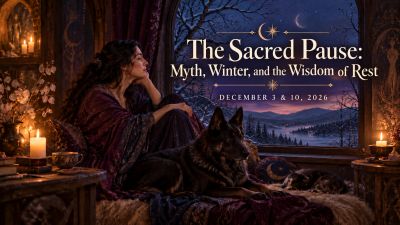
The Sacred Pause
Myth, Winter, and the Wisdom of Rest
A Two-Week Live Online Winter Gathering
Tuesdays, December 3 & 10, 2026
4:30–6:00 PM Pacific | 7:30–9:00 PM Eastern
$65
There is a wisdom in knowing when to become still.
As the year draws toward its close, the world around us often seems to accelerate. There are obligations to fulfill, celebrations to prepare, people to gather, and expectations to meet. Even our moments of rest can become another thing to accomplish.
Yet winter offers another rhythm.
Beneath the frozen earth, life continues in ways we cannot always see. Seeds lie dormant. Roots endure. The long nights invite us into a different relationship with darkness, time, and the unseen.
Across cultures and religious traditions, periods of waiting, withdrawal, contemplation, and renewal have carried profound meaning. They invite us to consider the relationship between activity and stillness, between what is visible and what develops quietly beneath the surface.
The Sacred Pause is a two-week exploration of the mythology, psychology, and sacred dimensions of rest.
Drawing from seasonal traditions, religious observances, depth psychology, and the rhythms of the living world, we will examine our relationships with stillness, productivity, darkness, and the passage of time.
Together, we will consider what it means to step away from the constant expectation of doing, achieving, and becoming, and to inhabit the present season with greater attention and intention.
Each gathering will weave together mythological and cultural exploration, guided conversation, personal reflection, and simple embodied or contemplative practices.
Our Two Gatherings
Week One — The Wisdom of Darkness
December 3
What happens when the world grows quiet?
We begin by exploring winter as a season of dormancy, inwardness, and unseen activity. Through mythology, seasonal symbolism, and the living rhythms of the natural world, we will consider the meanings human beings have given to darkness and the possibilities of withdrawing from ordinary activity.
A guided imaginal practice invites participants to explore their own relationship with stillness and the aspects of life that may be quietly developing beneath the surface.
Week Two — The Sacred Pause
December 10
What does it mean to give ourselves permission to rest?
Our second gathering examines sacred time, traditions of contemplation and intentional rest, and the cultural expectations that shape our relationship with productivity.
We will explore how ritual can create meaningful boundaries around our time and attention, allowing us to honor periods of uncertainty, reflection, and renewal.
Together, we will develop a simple personal winter practice that participants can carry into the weeks ahead.
An Invitation to Become Still
The Sacred Pause offers a space to approach the winter season with curiosity, reverence, and a willingness to listen.
Whether you are seeking a deeper relationship with seasonal traditions, an opportunity for meaningful reflection, or simply a different way of inhabiting the closing weeks of the year, you are welcome.
No previous study of mythology, depth psychology, or ritual is necessary.
The invitation is simple: to make room for what becomes possible when we allow ourselves to be still.
Registration Information
Dates: December 3 & 10, 2026
Time: 4:30–6:00 PM Pacific / 7:30–9:00 PM Eastern
Format: Two live, interactive online gatherings via Zoom
Tuition: $65
Both gatherings will be recorded for registered participants who are unable to attend live or wish to revisit the material.
Participants will also receive reflection prompts and simple contemplative practices for the winter season.
The Dangerous Woman
Monsters, Witches, Seductresses, and Female Transgression
Live Online • Six Weeks
Mondays, January 18 - February 22, 2027
4:30–6:00 PM Pacific
$150
Hosted by Morbid Anatomy
Throughout mythology, folklore, religion, and art, dangerous women appear with remarkable persistence. They turn men to stone, lure travelers to their deaths, practice forbidden magic, devour children, defy gods, and challenge the boundaries of acceptable femininity. From Medusa and Circe to Lilith, the witch, the vampire, and the femme fatale, these figures reveal the complicated relationships between femininity, sexuality, power, and fear.
This six-week course will examine the cultural history of the dangerous woman, exploring how female figures become monstrous, seductive, threatening, or transgressive, and what their stories reveal about the societies that imagine them. Drawing from comparative mythology, religious studies, folklore, art history, and archetypal psychology, we will investigate the ways female bodies, desires, knowledge, and authority have been represented across different historical and cultural contexts.
We will begin with the monstrous feminine, encountering figures such as Medusa, Lamia, and the child-devouring demons of ancient traditions. From there, we will turn to witches and sorceresses, including Circe and Medea, whose knowledge and powers complicate conventional distinctions between wisdom, danger, and transgression. We will also explore the seductive woman as seen in sirens, enchantresses, and the femme fatale, examining the relationship between desire and the fear of losing control.
The course also considers women who violate sacred or social expectations, from Lilith and Eve to historical women accused of witchcraft, and the ways religious and cultural authorities have shaped ideas about female obedience, sexuality, and deviance.
Throughout our discussions, we will examine how these figures have been represented and reimagined in visual art, literature, and contemporary culture. We will also consider why some dangerous women have become symbols of resistance, autonomy, and empowerment, even when their earlier stories carried very different meanings.
Ultimately, this course asks what makes a woman dangerous, who has the authority to define her as such, and why these figures continue to fascinate us.
Each session will feature a PowerPoint lecture exploring mythological narratives, historical sources, visual art, and cultural representations, with opportunities for guided discussion and reflection. Participants will examine how images of dangerous femininity have developed across different cultural contexts and how these representations continue to inform contemporary understandings of gender, sexuality, power, and transgression.
PLEASE NOTE: Classes will be recorded and archived for students unable to attend live.

Lilith by John Collier
